Drawing with the Whole Body: Heather Hansen’s Charcoal Performances
From Butoh to Charcoal
Hansen’s path to drawing ran through the theatre. She studied theatre design in Washington and Butoh dance in Japan. She was a student director of The Tempest in college when she was introduced to Butoh, and later moved to Japan to study with Kazuo Ohno and his son Yoshito. She studied Butoh under Kazuo Ohno for five years, and the slow, deeply physical discipline of that dance form still shapes the way she moves.
Japan gave her another influence too. She was inspired by the Gutai action painters, artists who famously threw materials like paint or clay at canvases in post-war Japan. Hansen took that idea of art as an action and made it quieter and more controlled.
Her training kept widening. She later moved to Germany, fell in love with the Italian Renaissance, and travelled to Florence to study its techniques. That grounding in classical drawing helps explain why her work looks so composed, even though it comes from improvised, full-body movement.
How the Drawings Are Made
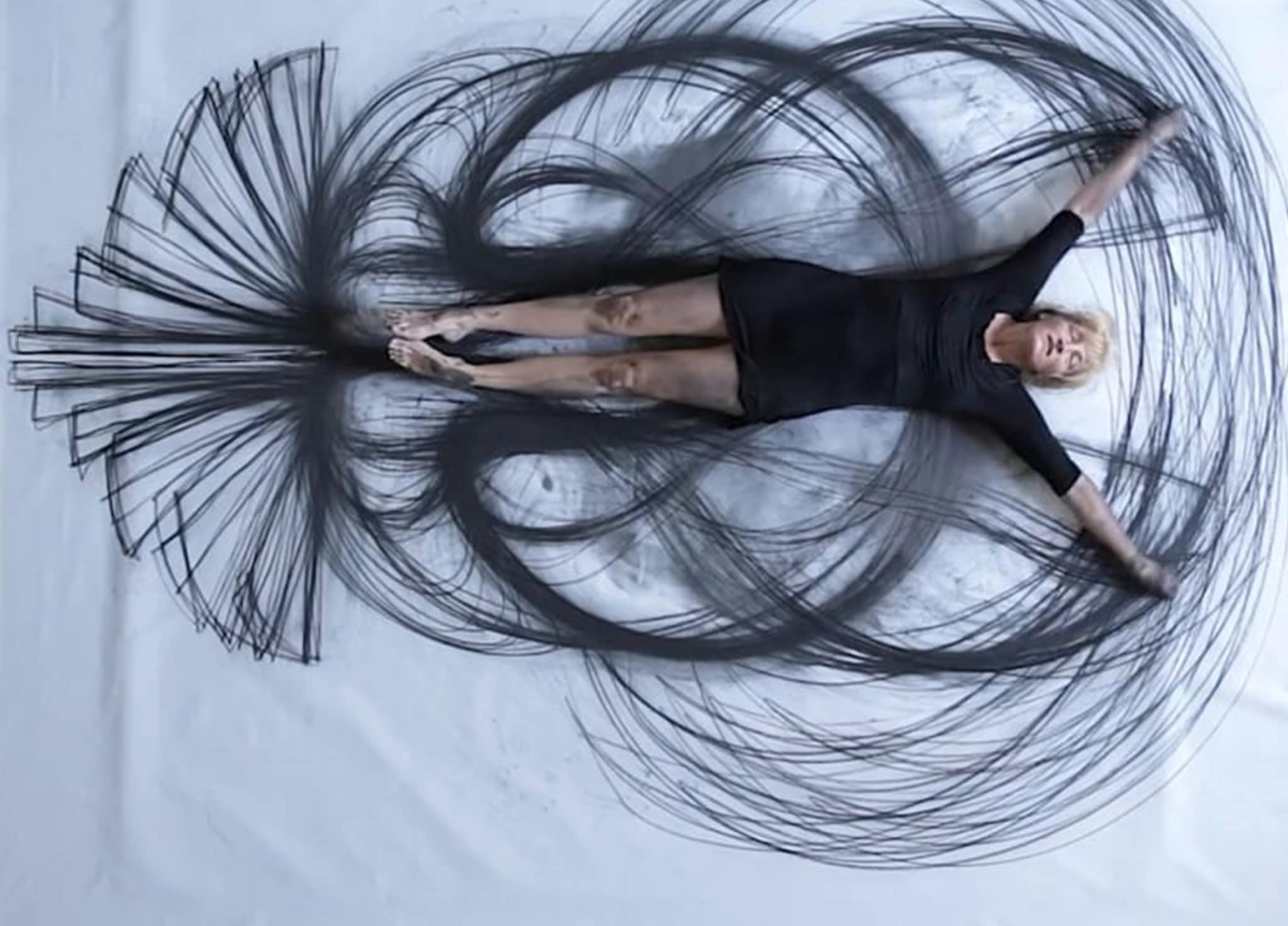
The method is simple to describe and hard to do. Holding pieces of charcoal in each hand, Hansen moves through a demanding physical routine on a large sheet of paper. Her body contorts into carefully choreographed gestures, and the long trails of charcoal become a permanent recording of her movement.
Her materials are plain. She works with just her body, gessoed canvas (occasionally Korean paper), charcoal and, sometimes, an audience. She makes fluid movements across the blank surface, building up shapes and patterns before smearing the lines. The smudging gives the work depth and a soft, smoky glow.
Many of the drawings are strikingly symmetrical. She rotates and rolls her body in yoga-inspired movements, likened to a Spirograph, to produce gestural charcoal drawings. Her arms sweep out mirrored arcs that echo snow angels, mandalas and the rings of a tree. Hansen says small imperfections keep the work from being perfectly proportional, and that this may be its greatest strength. The slight asymmetries are what make each drawing look human.
Silence, Breath and Audience
Hansen often draws in front of people. She has described the presence of an audience as feeling like a “high-stakes game of solitaire”. She prefers to draw in silence, because everything is motivated by breath and the sound of the charcoal, which makes the experience more intimate for both artist and viewers.
Watching her work is a different experience from looking at the finished piece. The scrape of charcoal, the pauses and the visible effort are all part of the work. The drawing that remains is what the performance leaves behind.
Emptied Gestures
Her best-known body of work is Emptied Gestures. The phrase refers to movements stripped of narrative or representation, so that only the pure physical act remains. The approach echoes certain strands of abstract expressionism, but her method is rooted in the body rather than the brush.
Hansen herself describes the aim in similar terms. She says she is searching for ways to “download” her movement directly onto paper, emptying gestures from one form to another and creating something new in the process. In her hands, a gesture is not a symbol of anything. It is simply an action that has been made visible.
Why Anchor Dance?
A deeper motive runs through the work. Hansen has observed that dance is often overlooked in the arts, partly because it is ephemeral. People remember that a performance felt beautiful but rarely recall the movements themselves, and she is primarily interested in finding ways to anchor dance. Charcoal is her anchor. She says it lets her record each gesture as it happens.
She compares the results to a photograph, a literal recording of a moment. Unlike a photograph, though, the drawing holds the whole duration of a performance, layered and smeared into a single image.
Kinetic Drawing in Practice
Hansen began experimenting with kinetic drawing in 2012, searching for ways to combine her passion for visual art and dance. Kinetic art is often thought of as three-dimensional, but she makes kinetic art in two dimensions, with her moving lines as part of the art.
Her work has found an audience well beyond galleries. It appears in school resources, where children discuss time, audience and drawing materials in relation to her practice. One elementary art lesson connected her process to making snow angels. The comparison works because her drawings are made by bodily actions everyone knows.
A Life Between Cities
Her work has been closely tied to two cities. She has been described as a fine artist working in New Orleans and Paris, and in Paris she has worked as an art director and choreographer while keeping a small studio. As with any working artist, her current base and projects are best confirmed on her official website.
What Her Work Teaches
Hansen’s drawings suggest that a mark can be a moment. A line of charcoal can hold a breath, a shift of weight or the arc of an arm, and a large sheet of paper can serve as a stage. For anyone interested in drawing, dance or the space between them, her work shows how much a body can say without a story attached.
To see her work, visit her website, heatherhansen.net, or look for videos of her live performances online.